
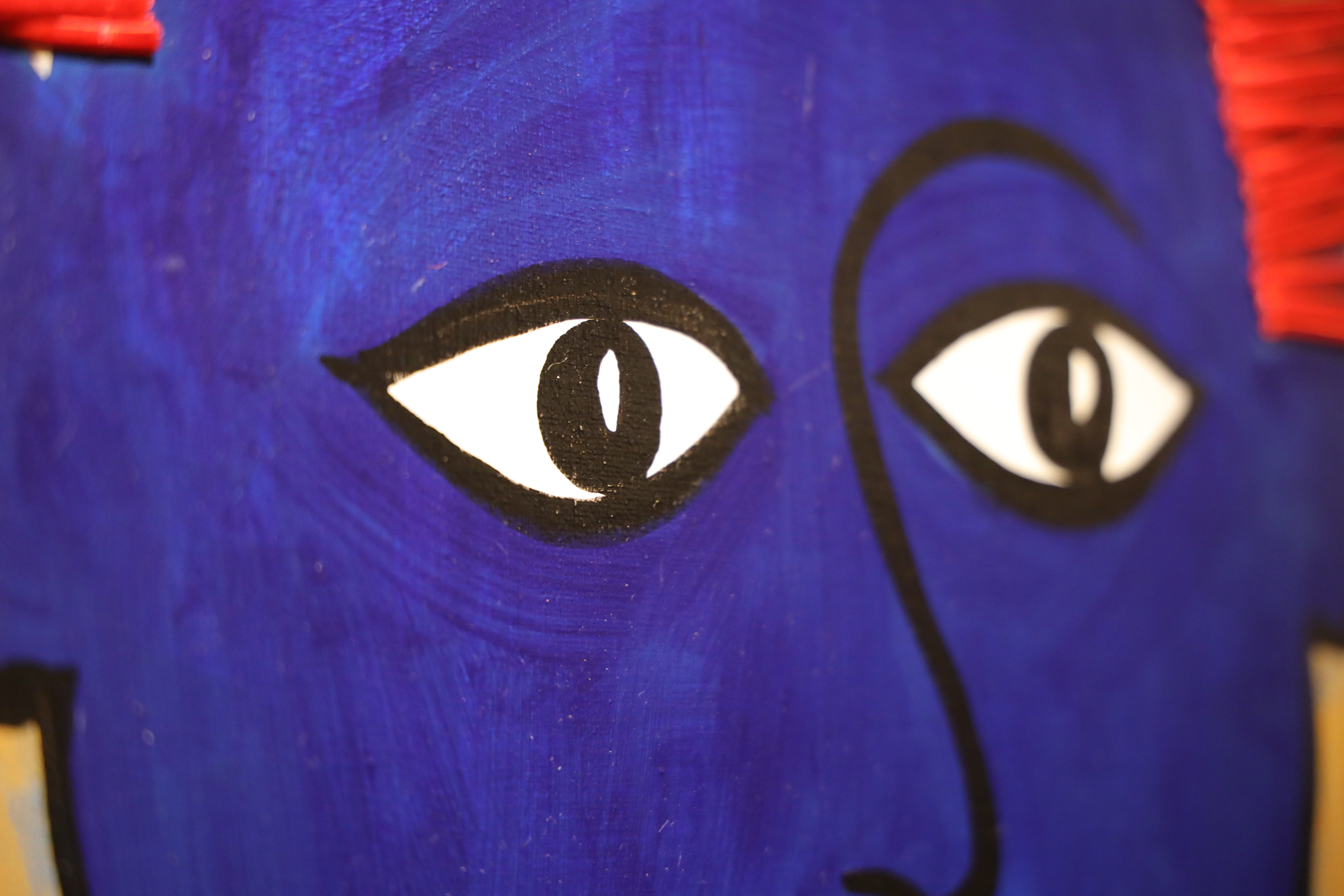
WOMAN began at home in Kochi, with a picture book. Reading with her children in 2020, Vanessa Meister noticed she couldn’t identify with the smiling mother on the page in salwar and long hair. She looked, in fact, more like the father: serious, short-haired, in a shirt. The first portrait answered back, a woman without a smile, mouth open mid-sentence. From that one canvas grew a collection of a hundred painted faces, asking who gets to be seen and heard, and what we lose when women appear mainly as decoration.
Each work is acrylic on canvas, finished with embroidered detail: trimmings, beads, sequins, yarn for hair, sometimes a woven hat. The surface becomes tactile and unmistakably individual. Needle and thread alongside paint sits inside an older argument. In the 1970s, Miriam Schapiro and the Pattern and Decoration movement coined the term femmage to insist that embroidery, fabric and “women’s work” belonged in the frame and not at its edge, and that ornament and textile were serious artistic languages rather than something secondary. Meister extends that claim into the present.
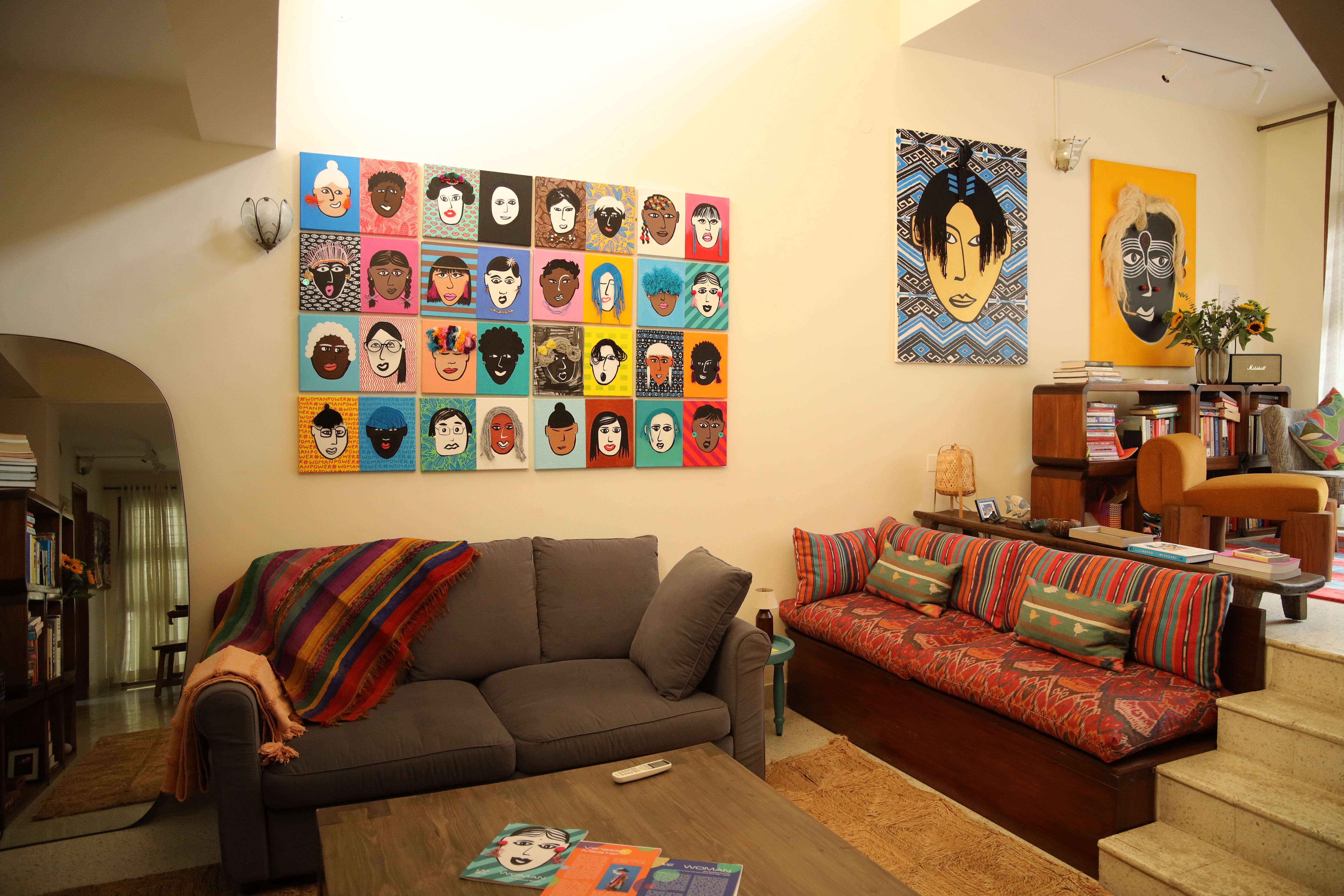
The cast is deliberately wide: founding mothers and hip-hop girls, schoolgirls and witches, an Indigenous elder, a pirate, two queer women meeting at the Delhi Pride parade. In one canvas, Krishna is reimagined as a woman, feminine and graceful but short-haired, an ambivalent figure with a sensuous red mouth on a ground washed in gold. The iconography of Indian devotional painting is held intact while its gender is quietly turned. Elsewhere, the Spanish actress Rossy de Palma, whose career was built on refusing conventional beauty, sits beside a track-and-field athlete in braids: a body trained for what it can do rather than how it looks. The patterning is dense and the colour loud (pop dots, mud-cloth grids, tropical leaves), and the bold black outline is the constant, recalling Alice Neel’s hard-edged sitters. Psychological presence is chosen over prettiness. The portraits do not flatter. They insist.
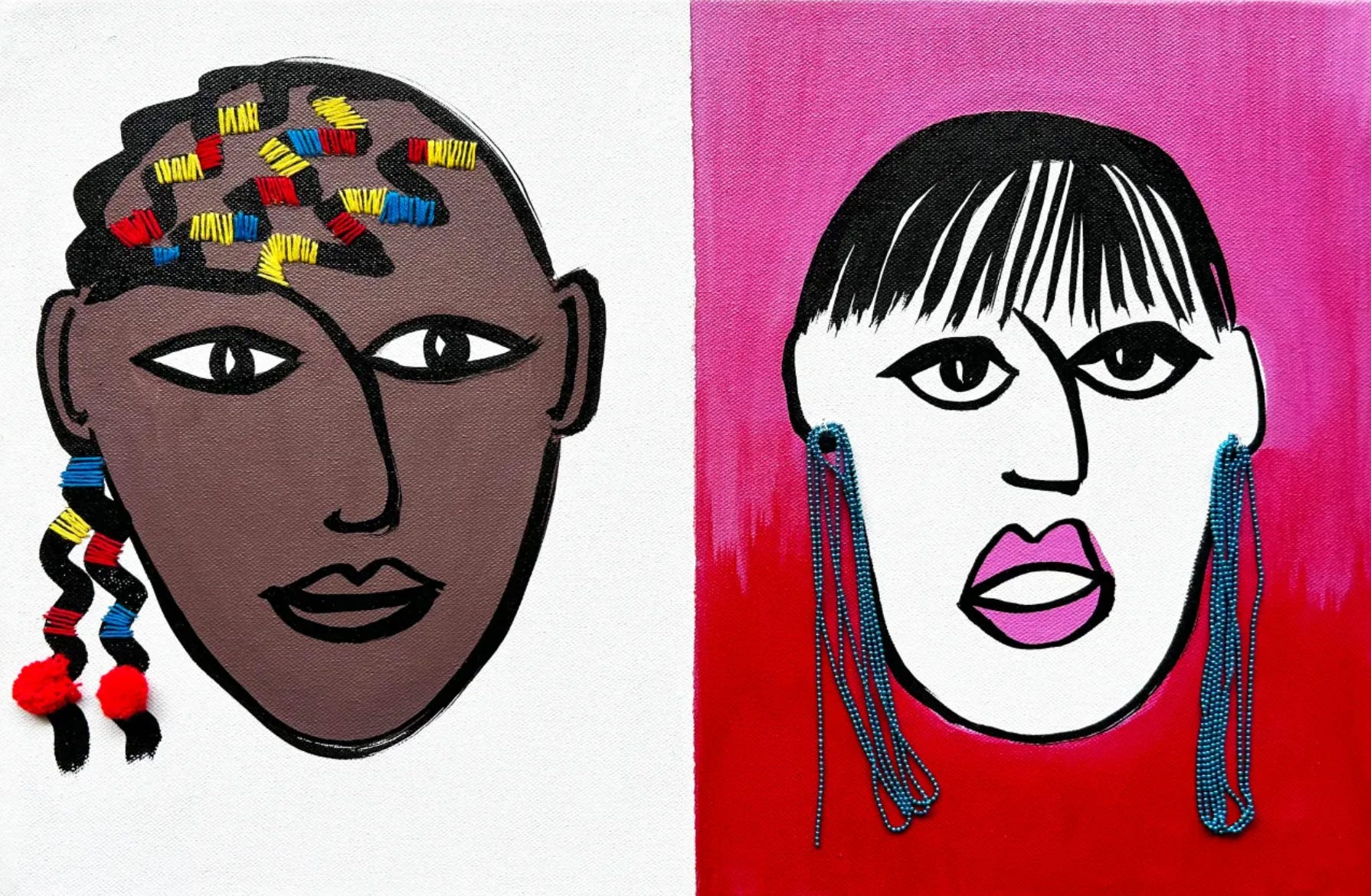
Image: Athlete + Rossy de Palma, Acrylic on canvas + embroidery, 18 x 12 in
Begun in a year that pulled most of us back into the house, WOMAN is both a private studio practice and a public argument: the images we live with, in children’s books, on rugs, in card games, on the walls of our houses, shape who we believe we can be. By moving the work between canvas, hand-tufted rug, card game and exhibition, Meister refuses the old hierarchy that separates fine art from craft, and the gallery from the home. Each face is a refusal of the silent, smiling woman. A hundred of them, in one room, are harder to ignore. The invitation, on entering, is to look properly, and then to listen.
— Curatorial note, WOMAN (2020 – ongoing)