
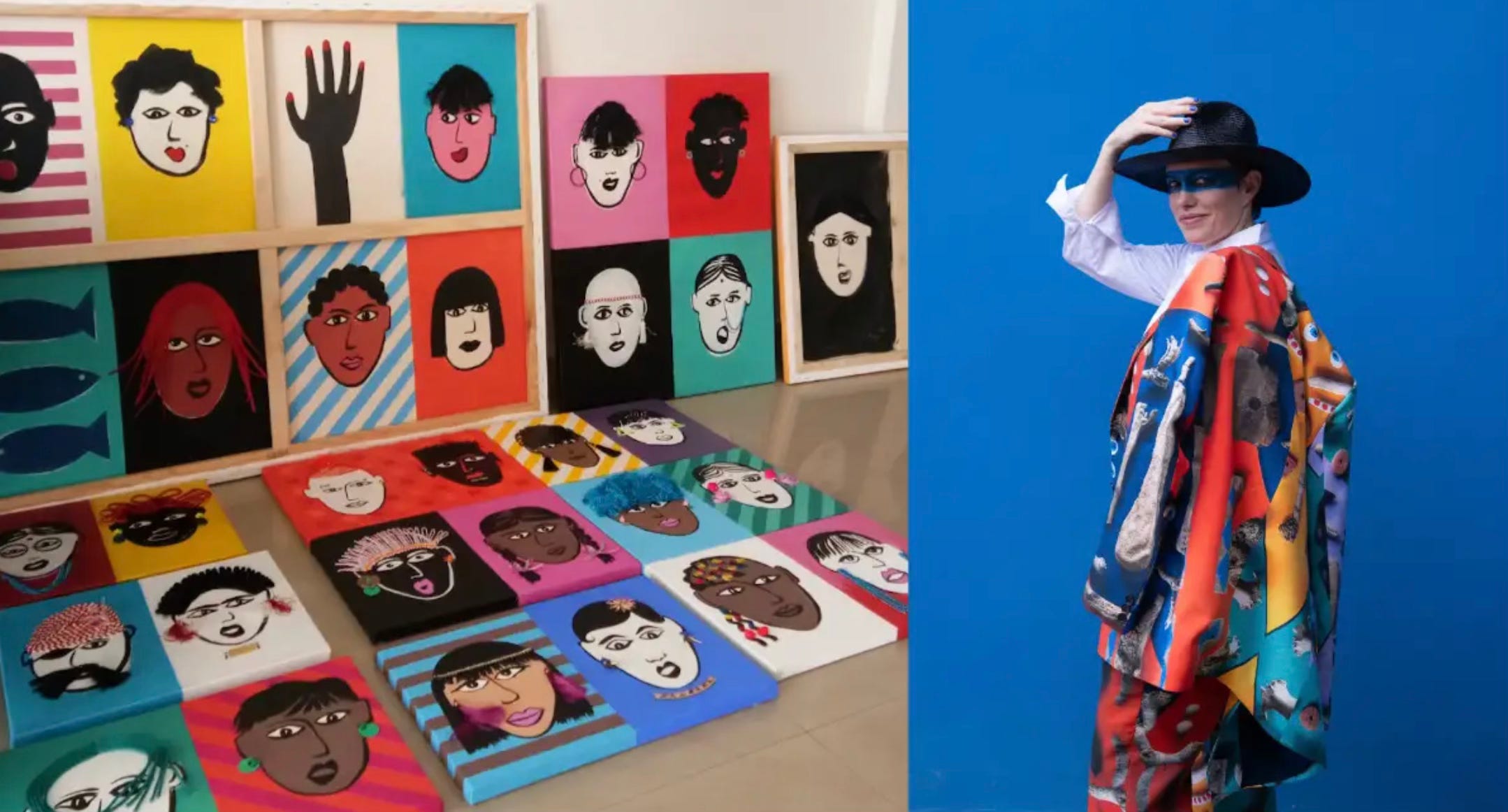
WOMAN began in 2020, when Vanessa Meister was reading a children’s book at home with her kids and realized she could not see herself in the smiling mother on the page. The first portrait answered back: a woman without a smile, mouth open mid-sentence. From it grew a series of a hundred painted faces. Founding mothers. Hip-hop girls. Schoolgirls, witches, an Indigenous elder, a pirate, two queer women meeting at the Delhi Pride parade.
We sat down with the artist to talk about the process and muses behind her ongoing series.
You trained in industrial design, built a career in fashion and creative consultancy, and now also maintain an independent art practice with the WOMAN series. In your experience, do the design mind and the artistic mind work differently? Do you find yourself switching modes, or do they feed into each other? And if so, how?
I would say a bit of both, and here’s why. When I work on a brief from a client, my mind is looking for the best way to solve a problem with a set of parameters. I put myself at the service of a brief. When I work on a new visual concept, I need to relax and let things come together until something sparks. For this, I’m like a detective gathering clues; I need time. Sometimes the pieces have been accumulating for months or years (like the trimmings) until all the elements fit together. It’s also about where I am personally in life, trying to find a visual manifestation for an idea that is preoccupying me.
For the WOMAN collection, I was at a turning point personally in my life - questioning my own identity as a woman and a mother. It coincided with the pandemic, which allowed me time and space to explore this question.
What is common throughout my practice in art and design, though, is my own expectation of how the work should look and be sent out into the world. A tightness in concept, a sharpness in execution and a clear way it’s shown to the public. Once the essence of the idea is reached, the core of the vision - I can apply my design mind to create merchandise, collaterals or move the work into another sphere.
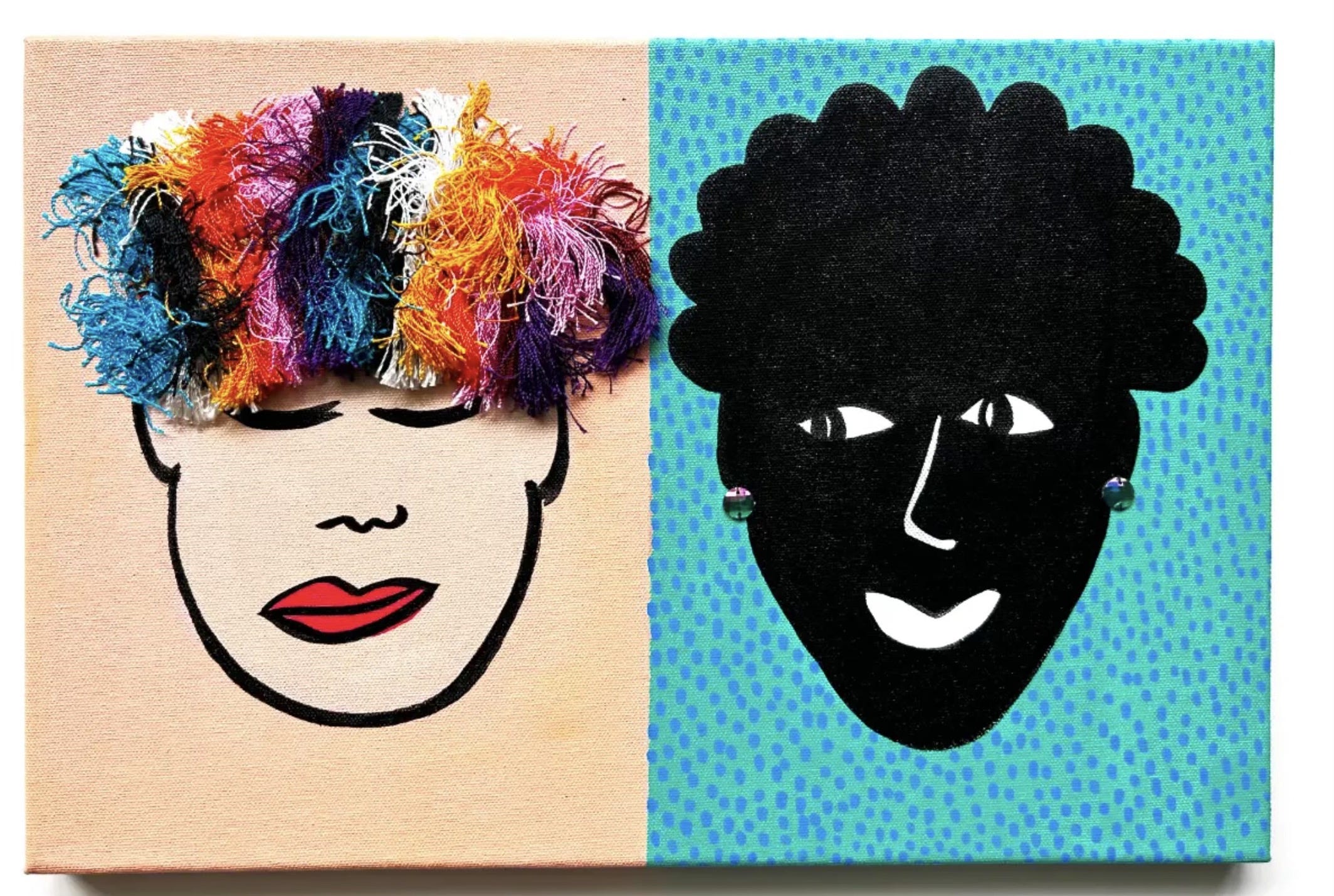
Image: Pride campaigners, Acrylic and embroidery on canvas. 18 x 12 in.
Your practice blends painting with embroidery and found trimmings, and you have chosen portraiture as the central format for WOMAN. Could you speak to how these two choices—mixed media and the face as subject—work together to achieve what you set out to say about representation?
I bought a big bag of trimmings, sequins, lace, and beads from Chandni Chowk (New Delhi) in 2014. I had been saving these for a special occasion, chasing an intuition, looking for a way to use them intentionally. When I painted the first portrait, I felt like adding detail, an element of surprise, something extra. The trimmings were a perfect fit, complementing the paint with tiny spotlights. I do not believe in glue (or umbrellas); it was essential to me that these were stitched onto the canvas - if you turn the painting around, you see the stitch. I needed the trimmings to be part of the paintings, not just an add-on.
The face became central because it is the place where individuality, identity, emotion and projection meet. I chose to focus on the face, keeping the body perhaps for a later collection, and develop a system that I could scale in numbers. Even though some vary in scale, they are all given equal status. There was also a play with colour and texture, like an exercise in repetition and variation, as well as a search for nuance and depth, that unfolded over the period I painted. Over time, I went from painting physical attributes - hair, eyes, mouth - to trying to express emotion, personality and action - eyes closed, mouth open, singing or talking, details that hint at occupation or background. I started to see more layers and complexity.
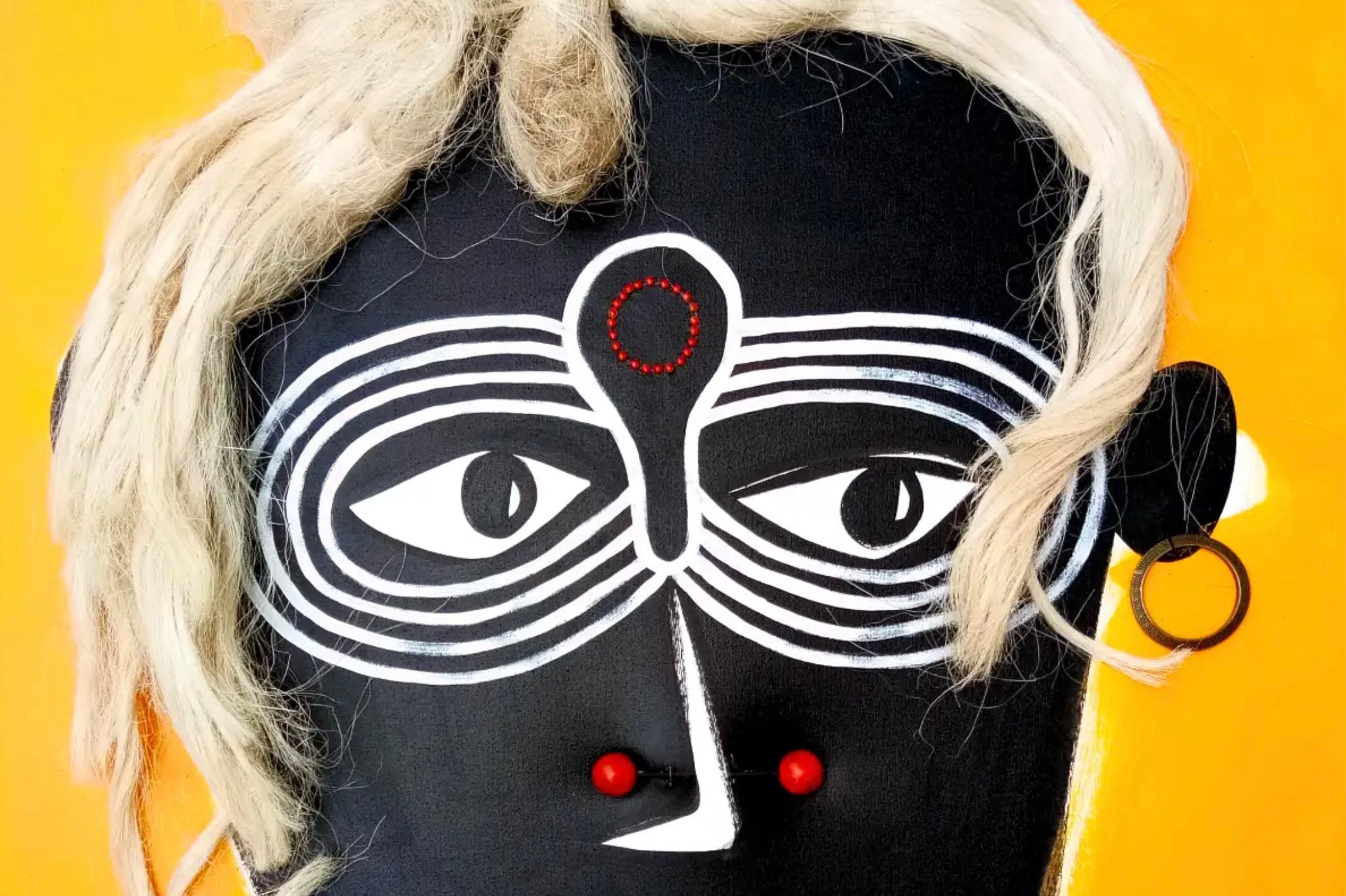
Image: Founding mother yellow, Acrylic and mixed media on canvas. 18 x 12 in.
The first portrait emerged from not recognizing yourself in a smiling mother. You painted a woman with an open mouth, mid-sentence. One hundred portraits later, what do you find yourself searching for now in a woman’s expression? What do you hope to capture that a smile cannot hold?
I want to see a real emotion - maybe anger, grief, annoyance or mischief, ecstatic joy. I want to see what’s below the face we project to the world. Something honest and raw, that has not been cleaned up to look nice. I also find myself meeting people that way - not always in the perfect version I would like it to be. Something alive and real rather than composed and perfect.
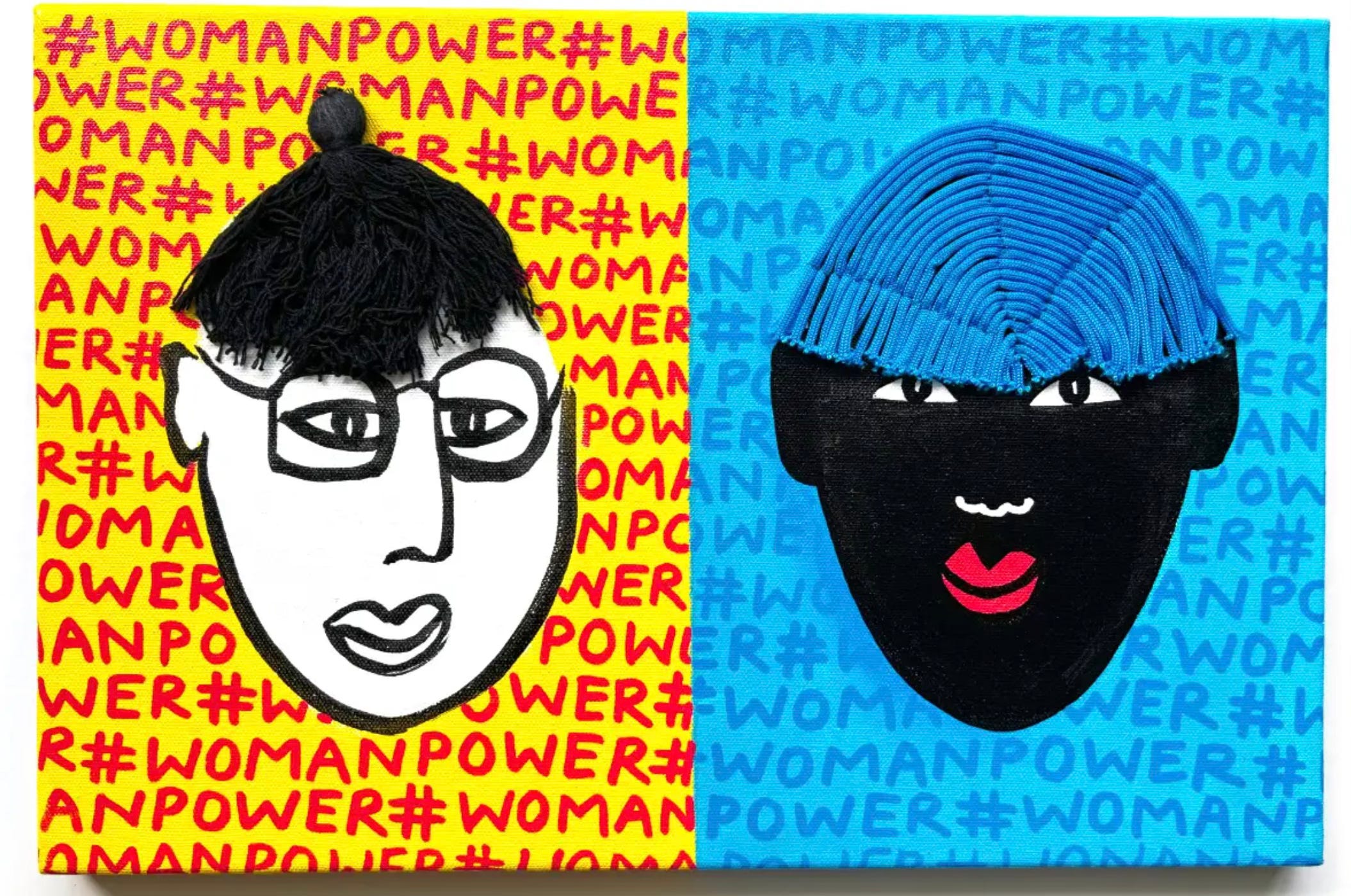
Image: Intellectual + activist, Acrylic and embroidery on canvas. 18 x 12 in.
On listening as artistic practice, you said, “I felt they wanted to be heard and seen, so I listened and gave them a place to be themselves and free.” How has listening to these women over the past several years changed the way you see or represent women in your own daily life?
It showed me that there are plenty of ways to be a woman, express femininity (or not). There are millions of ways a woman can look, feel, work, and love, and all are valid. I grew up seeing a very specific way that life should be lived: education, marriage, relationships, and parenting. Becoming an adult and a parent, I realized some (a lot) of these things didn’t work for me, and I needed to carve my own way. Looking at the women around me, I felt inspired by the way they cope with adversity, how they hold grief, express joy, and live in their bodies. I opened myself up, questioned and tried to understand how to move through the world at a pace that suits me. I also wanted more women to feel represented and celebrated. I hoped some visitors would recognize themselves - a physical attribute, an emotion - and think, ‘oh, that’s me’.
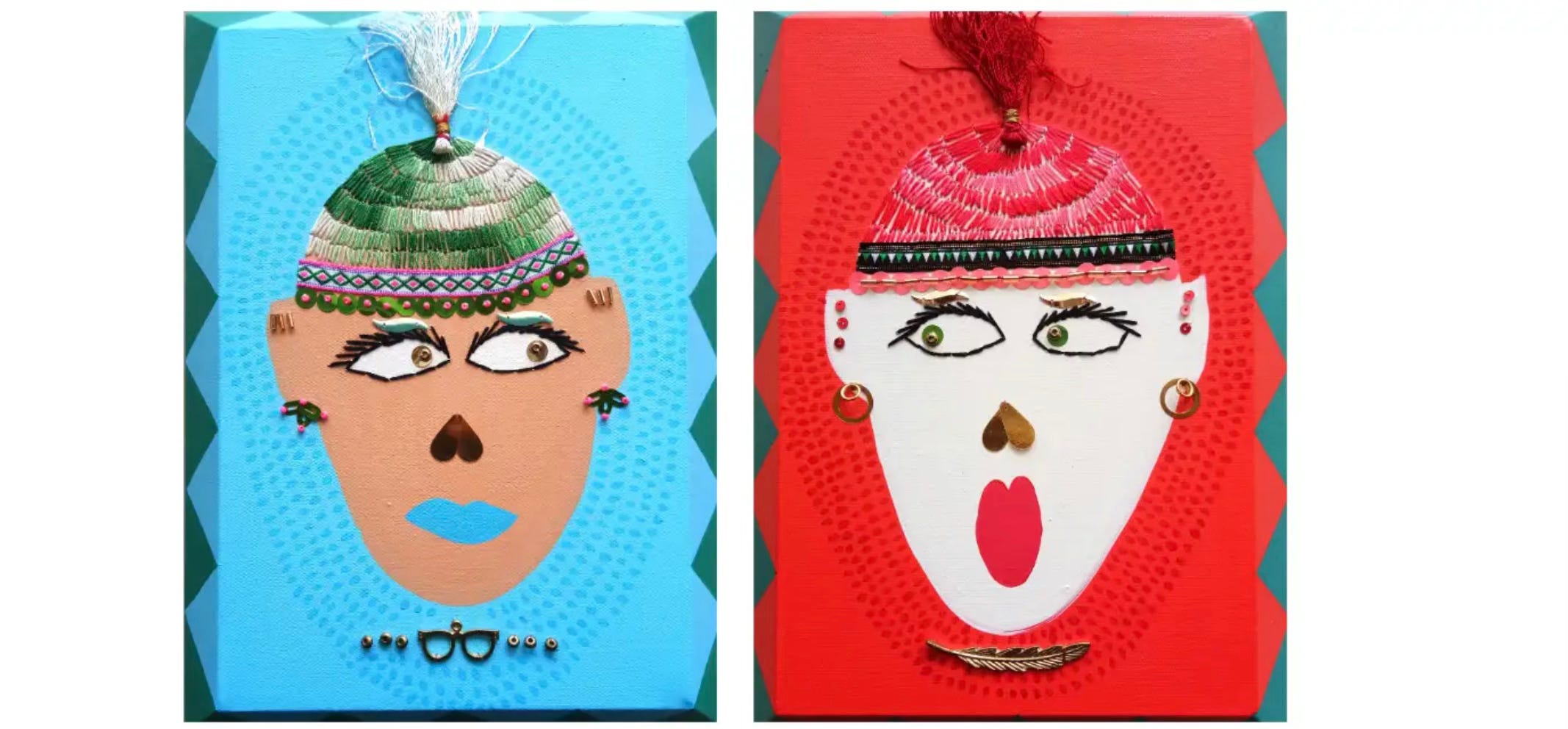
Image: (L) Blue witch (education) & (R) Red witch (health), Acrylic and embroidery on canvas. 9 x 12 in each
You described a moment where you began inviting the women to “come to me” and asked yourself, “Who’s next?” Can you walk us through that imaginative space? When a figure like an activist, or an old lady with a tough life, arrives, how do you know she’s the one, and what does she bring with her that guides your brush?
Initially, I worked on representing as many different women as I could. I consciously chose different hairstyles and skin tones. I was trying to build the collection from memory from my immediate circle, slowly widening it further geographically and emotionally. I wanted to add a woman from Japan, and painted the outline of a Geisha. Why should the Japanese woman necessarily be a Geisha? It led me to question - where do we use collective references, and where do stereotypes start? So I made the Geisha angry, I didn’t want her to be as expected.
At one point, I made a decision not to censor myself: I never fixed a paint stroke. I let each face be as it came. One has a wonky eye, so I let it be. There was a sense of radical acceptance. I thought of the immensity of the world and the number of women alive, so many different lives. All are welcome.
I wanted this collection to be like one big resting place for someone to come, and just be for a moment with me.
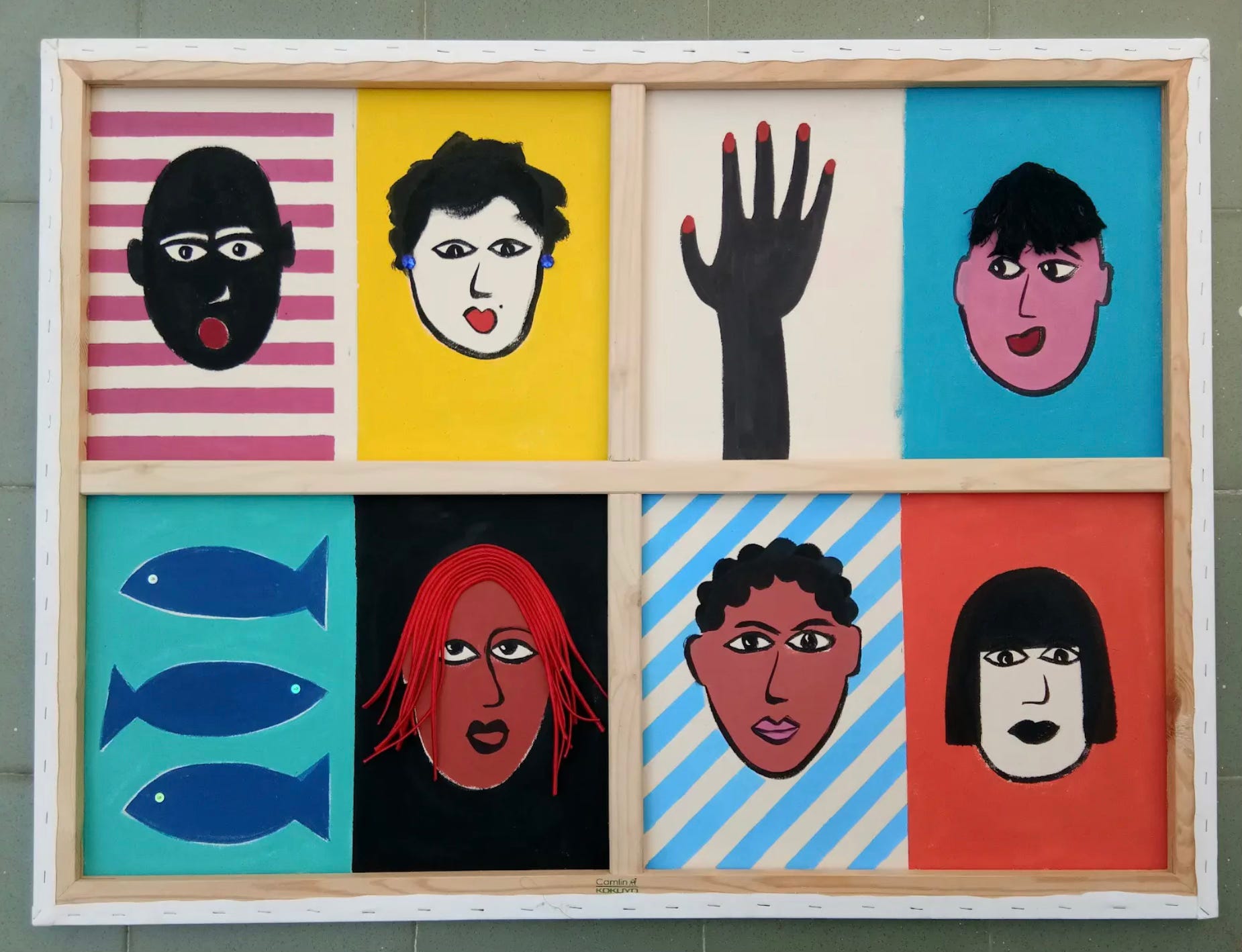
Image: Family riddle, Acrylic and embroidery on canvas. 48 x 36 in
The LMSA Take
Portraiture is ancient, but Vanessa Meister renews it through a material vocabulary that fuses surface technique with tactile presence, giving each unsmiling woman a life beyond the canvas.
Vanessa Meister works across design and fine art, and that fluency shows. The hand-tufted rug, the card game, the merchandise and workshops— each extension of the collection multiplies the conversation. But the core remains the painted face. To acquire a WOMAN portrait is to bring home a specific character: one of one hundred, yet utterly singular. It is to live with someone who refuses to smile on cue, refuses to ‘perform’ as a woman, someone who exists as a complex, multifaceted human.
For the collector who values representation that moves beyond the stereotypical—into humour, dignity, and the messiness of real presence—this series offers a generous and enduring companion.