
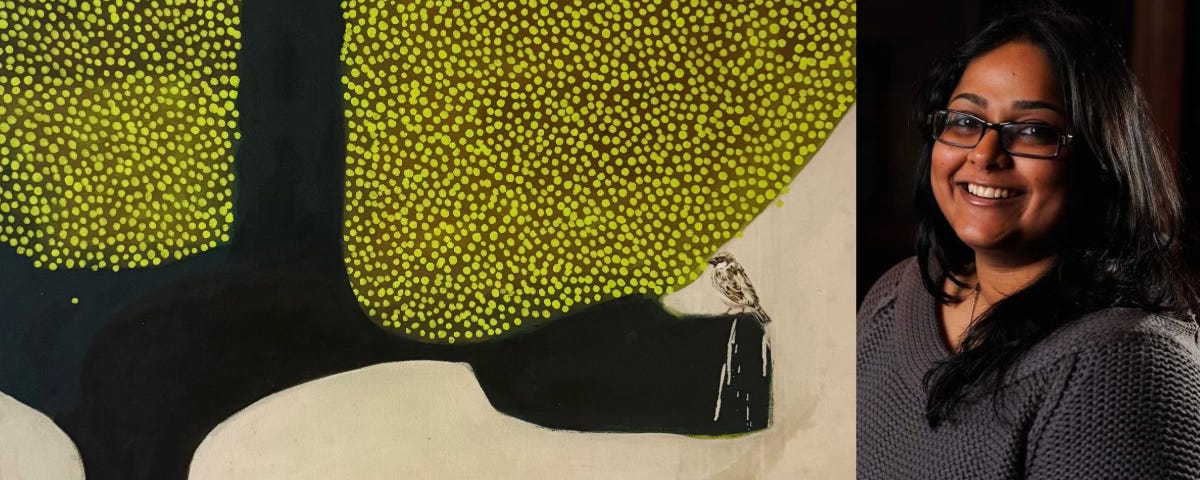
Most conversations about art collecting start with the investment value, the provenance, or blue-chip names. This one starts with a birthday gift to oneself: a painting of a radio meant to capture the sound of rain on a lazy afternoon. For National Award-winning screenwriter and filmmaker Shalini Ushadevi, collecting has never been a calculated strategy. It is an extension of how she feels and interacts with the world around her: following instinct, emotion, and the strange pull of an artwork that refuses to leave her alone. There is no advisor, no five-year plan, no spreadsheet of comparable sales. The appraisal value comes largely from gifting and exchanging art with friends (some of whom just happen to own art galleries).
In our first-ever collector feature, Shalini talks about discovering new artists, unpacking the emotional logic behind each acquisition, and why a great collection rarely follows a straight line.
Did you grow up around art, or was collecting a world you discovered on your own?
I grew up around traditional and artisanal art. My interest in more contemporary forms of art grew organically when I started going to galleries and museums as a student.
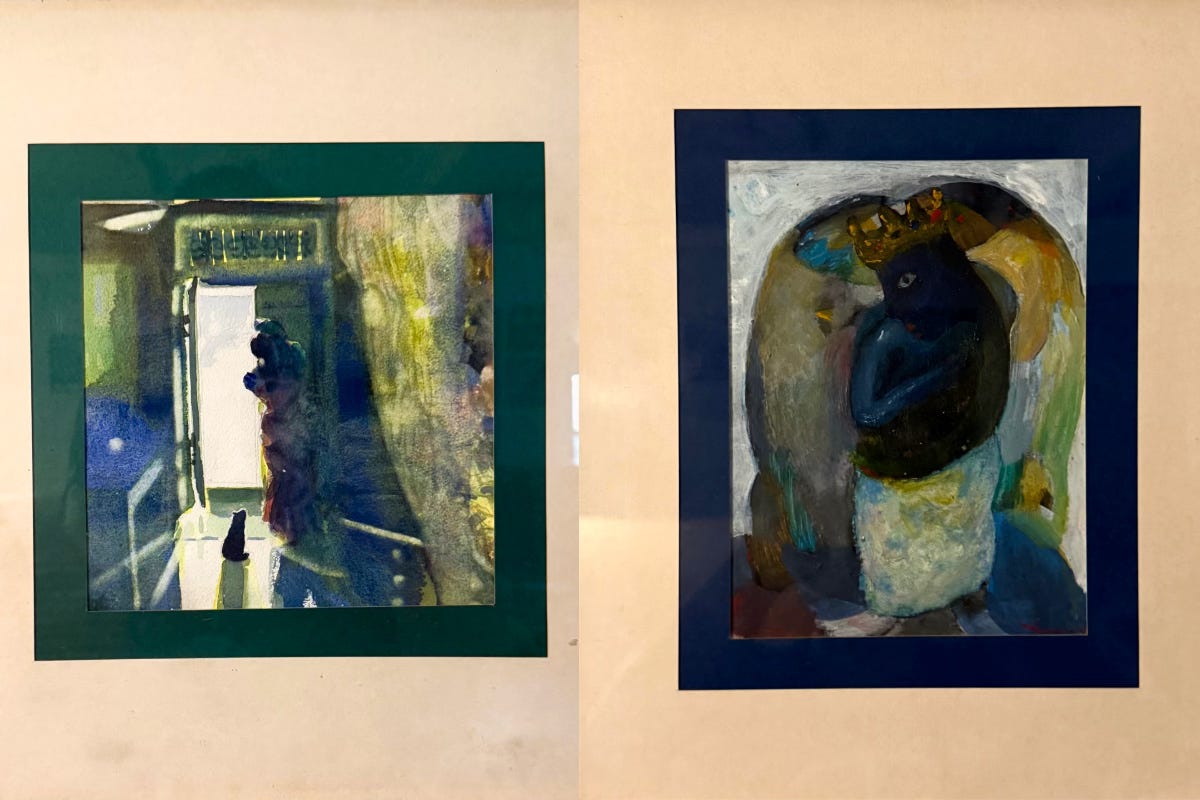
(L) Tender Moment, Danasegar Saminadin. (R) Black Princess, Venkatesh.
Do you remember the first artwork you acquired? How did you acquire it? What made you bring it home?
I don’t think there was a conscious decision to start collecting art. A watercolour by Pondicherry-based artist Venkatesh was one of my first acquisitions.
My first purchase was Ezhilarasan Ezhumalai’s Radio, which I saw at an exhibition at a friend’s gallery. It immediately spoke to me. It was meant to capture the feeling of listening to the radio on a rainy afternoon. It was so evocative and nostalgic. I bought it as a birthday gift to myself.
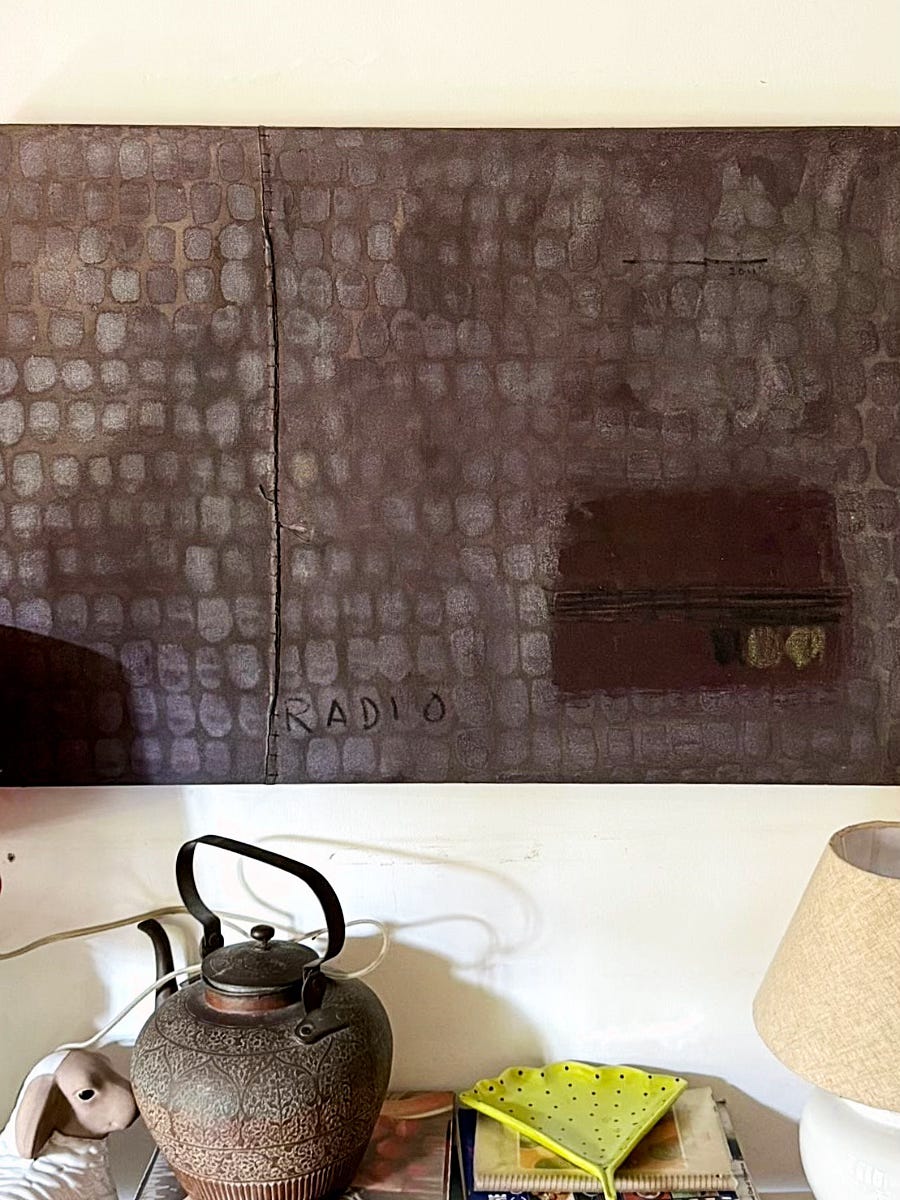
Radio, Ezhilarasan Ezhumalai.
How do you discover new artists?
I try to visit the art galleries in any city I travel to.I picked up a ceramic sculpture from Hydra, Greece. I bought a mixed media (acrylic on wood with recycled metal) work when I was visiting Cape Town. I also follow a few art pages online and look up the artists they feature.
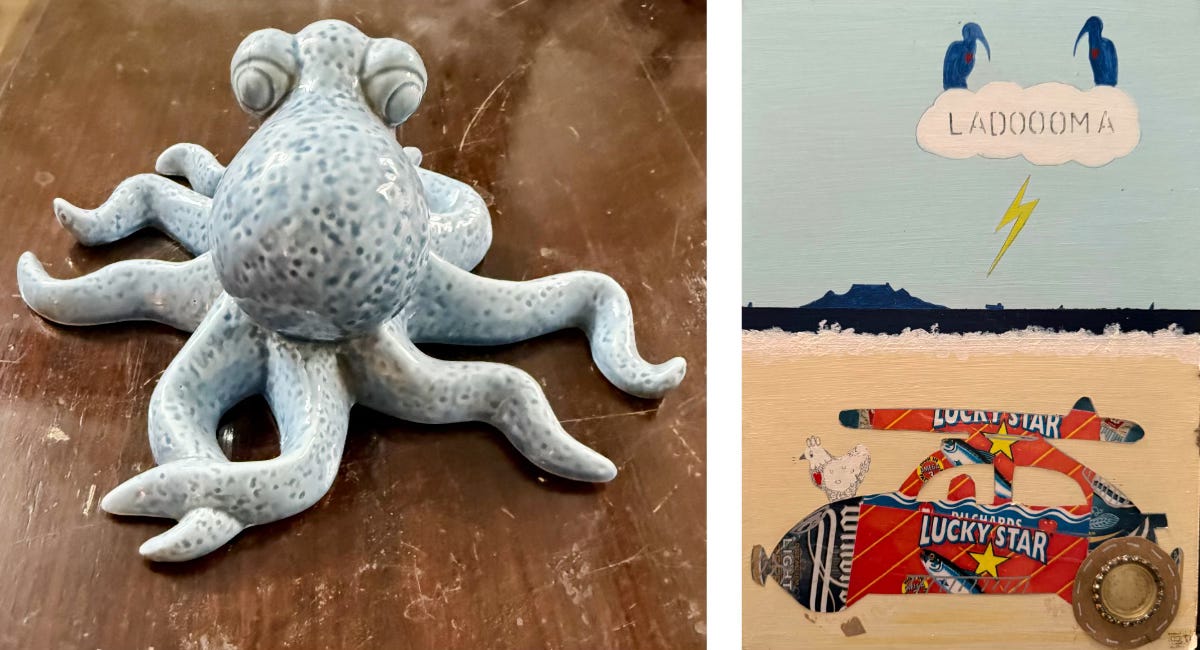
(L) Octopus sculpture from Greece. (R) Mixed Media artwork from Cape Town.
Some of my collection is simply gifts. My friend Cilara made this abstract for me for my fortieth birthday. One of my favourite paintings is from my producer/artist friend, Natasha Chopra. I love the colours, the humour, the whole vibe of the painting. In fact, I have it as my phone’s screensaver because it always puts me in a good mood.
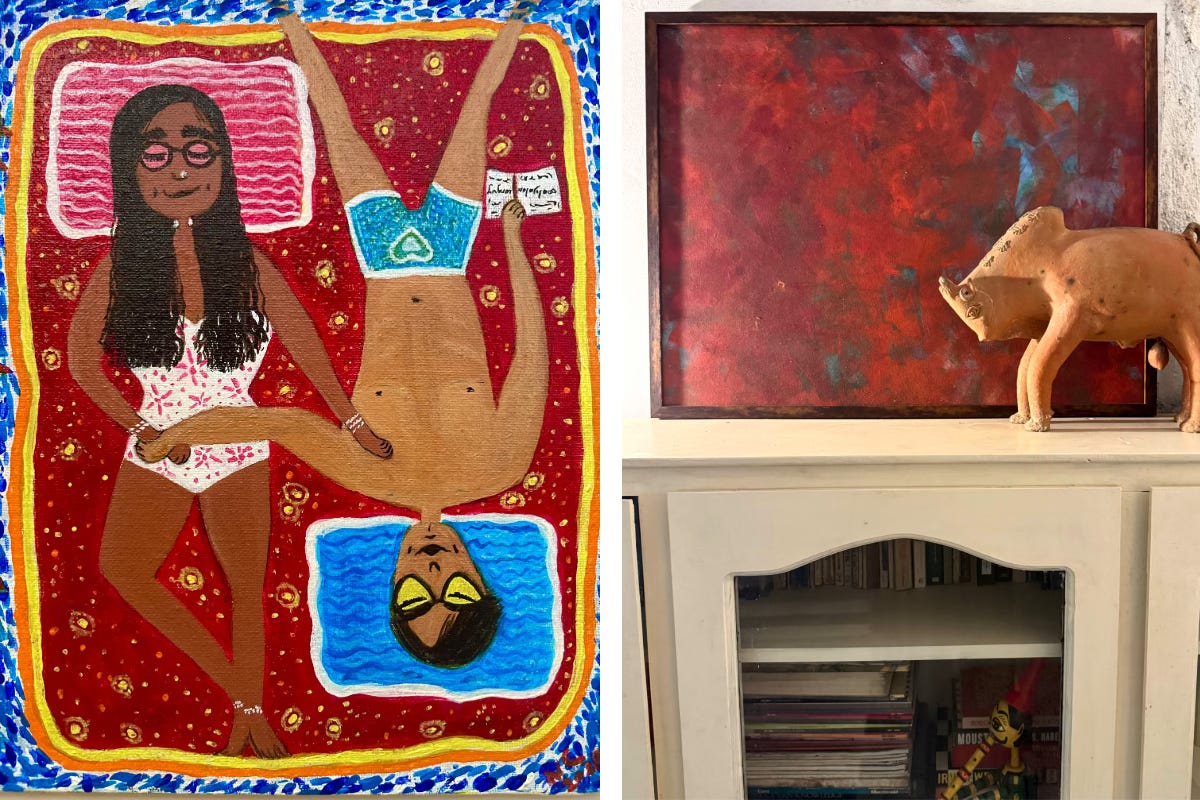
Gifted by (L) by Natasha Chopra and (R) Cilara Jacob.
If your collection were a movie, what genre would it be?
It would be an absolute potboiler. It inspires a whole range of emotions in me. It is also wildly unpredictable. I am often surprised by my choices and what they make me feel afterwards. So, a potboiler with a lot of twists.
You have two striking paintings by Ezhilarasan Ezhumalai. How did you discover his work?
I discovered him at an exhibition at my friend’s gallery, Gallery 360. His work immediately spoke to me, and I bought Radio there. If you see it in real life, it reveals these silver streaks evoking rain. I love how it changes personality depending on the time and lighting.
I bought A Regular Place at an exhibition of his works at the Alliance Francaise in Trivandrum. It gives me a sense of homecoming. I love how singular and anchoring it is while remaining whimsical and humorous.
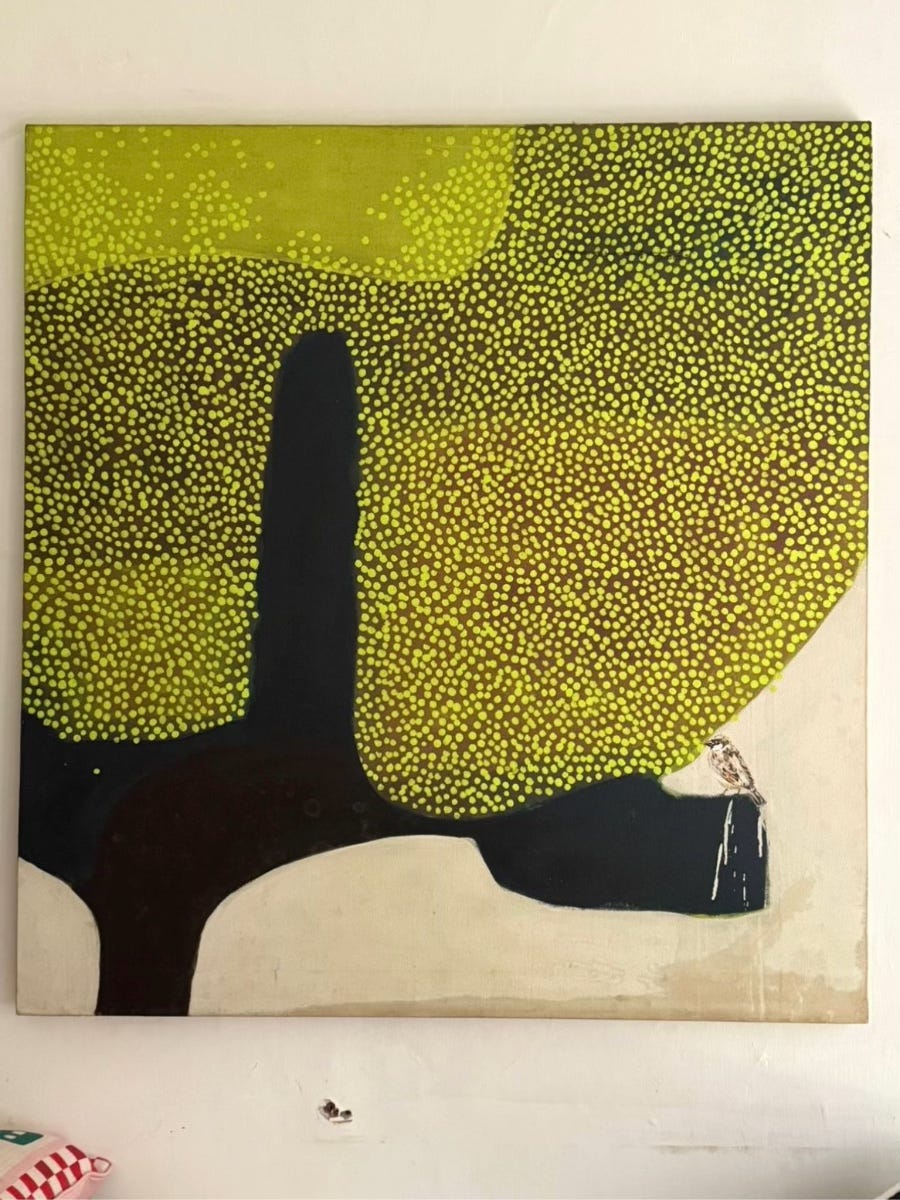
A Regular Place, Ezhilarasan Ezhumalai.
You mentioned you’re almost certain about an artwork when you first see it. What are some of the factors that seal the deal for you?
I give myself a few hours, or sometimes days, to see if I miss having it with me or in my home. If I don’t immediately have a place for it or don’t mentally rearrange things to accommodate it, then I decide it is not for me.
How would you describe the visual thread that ties your collection together?
If there is a common thread, I am unaware of it. I have a whole range of interests, and I think the art I am drawn to reflects them. In that sense, they help chronicle my interests. Like a record of who I was when I acquired that piece.
Has your taste evolved significantly since you started? Is there a style you collected earlier on that you would no longer collect today?
My taste has evolved, but I still love everything I have collected along the way. As I mentioned earlier, they each mark some sort of life stage. So, while I may no longer collect some of the pieces, I value and treasure everything I have bought.
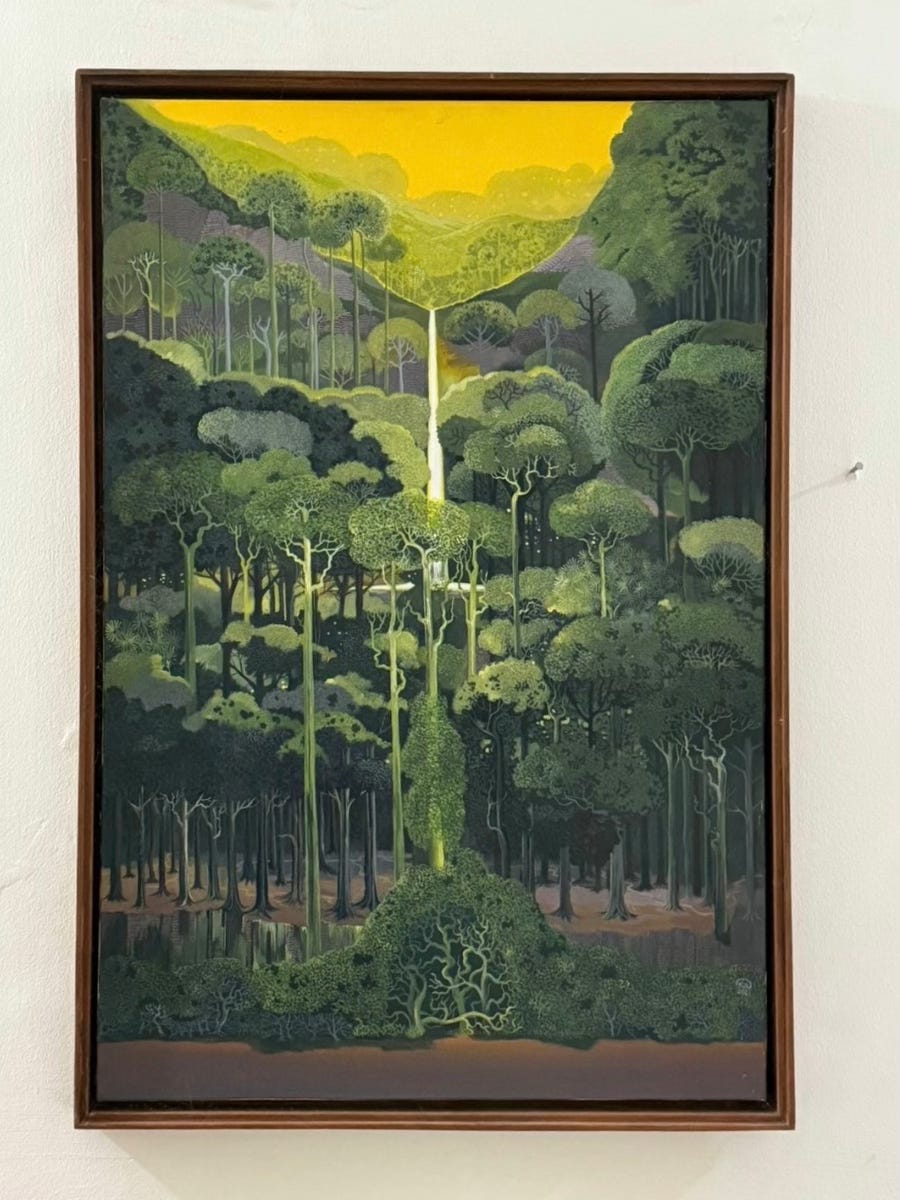
Ghost Trees, Shaji Appukuttan.
Shaji Appukuttan’s ‘Ghost Trees’ lends a fresh energy to your collection. What drew you to it?
The captivating drama of that intense yellow against that rich, almost mysterious, green pulls you in. I find trees and that landscape immensely comforting and abundant. In short, if there is a painting I want to walk into, it is this one.
Let’s talk about your latest acquisition. What about the artwork captivated you? What do you think it adds to your existing collection?
At this antique store in Finland, I stumbled upon ceramic plates in blue and white with scenes depicting different kinds of collective activity. They had years on them, embossed in gold. I picked up 1980, which was the year I was born. This might sound strange, but it made me feel connected to people who share my birth year.
My most recent additions would be the two ceramic sculptures I discovered on LMSA. I simply loved Surabhi’s style, and I can’t wait to find a nice spot for them at my new place.
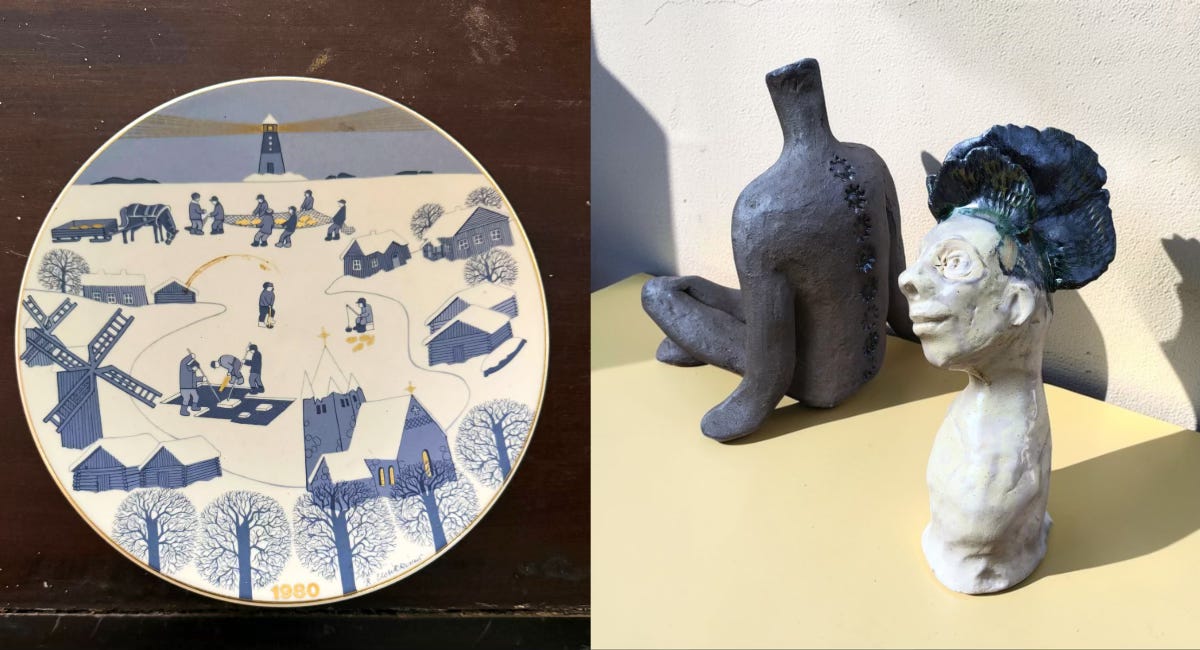
(L) Ceramic Plate from Finland, 1980. (C)Untitled 11 & (R) Portrait III, Surabhi P.
About The Collector’s Eye
We started this series for collectors and art lovers trying to navigate the strange and at times, opaque world of contemporary art. Discovering and acquiring original artwork can be deeply fulfilling at any budget or experience level. Whether you own two pieces or twenty or are just starting, we hope to bring you helpful advice (and stories) from art collectors on discovering new and rising artists, and building collections that reflect who you are.
Expect honest conversations with real collectors at different stages of their journey about the thrill of a first purchase, the anxiety of the second, and the hard-earned confidence of trusting your own eye. Each feature will give you insight into other collectors’ buying habits, blind spots, and teachable moments, so you can borrow what works and ignore what doesn’t.