
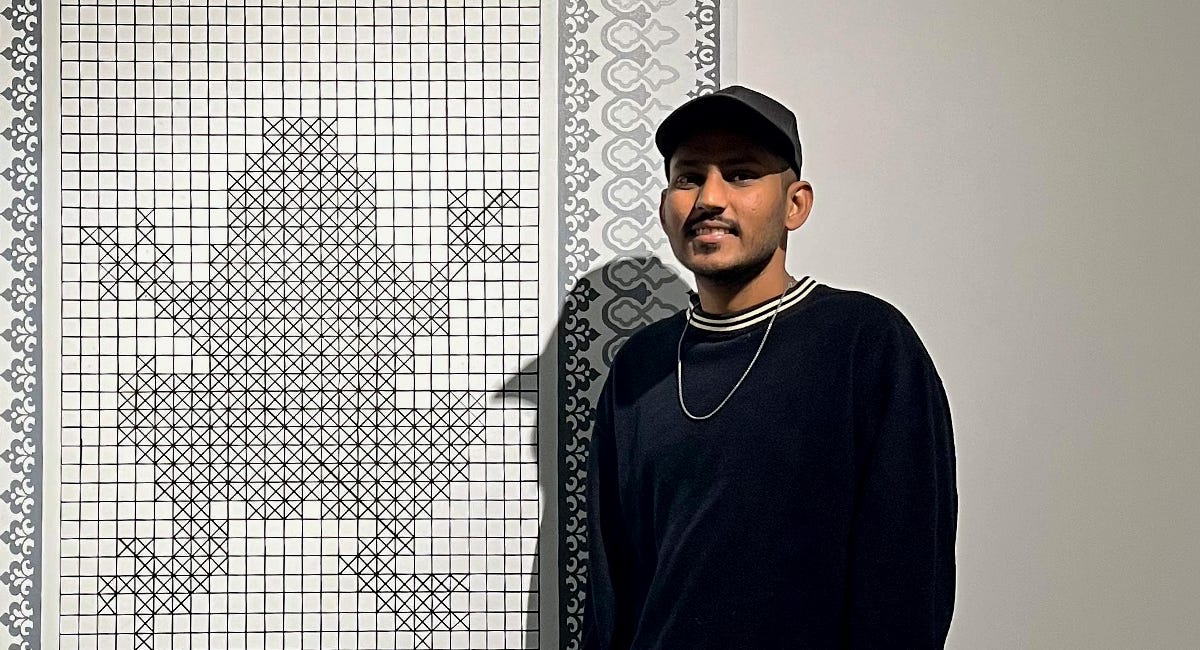
Riaz Ali makes you question everyday realities with his imposing canvases. The Lahore-based visual artist wields a sombre, controlled palette and unrelenting conceptual focus to drive socio-political commentary. Through symbolic everyday objects, his works expose the class hierarchies and social values that colonialism planted in the subcontinent’s imagination, structures that persist, beyond history books, in how people see themselves and each other, in what they aspire to and what they are ashamed of.
We sat down with the artist to peel back the layers of meanings and materials that shaped his series.
1. What voices do you find are often absent from the archives you consult, and how does that silence shape your material choices?
The ordinary ones: the farmer who grew the opium, the student who sat in the colonial classroom, the craftsman whose visual traditions were quietly pushed aside as inferior. Colonial archives are extraordinarily detailed about systems, policies, and structures of power, but almost entirely silent about the people those systems acted upon. That silence is not accidental; it is itself a form of colonial logic, where only the powerful are considered worth recording.
This shapes my material choices directly. Rather than working with archival documents or text, I turn to objects: the gun, the frog, the opium flower, things that existed in the lives of ordinary people, things that were handled and encountered every day. The grid I paint them on mirrors the way colonial education reduced complex living realities into simple, manageable lessons. The jadwal and hashiya I borrow from miniature painting traditions are themselves a recovered voice, a form of indigenous knowledge that was never absent from the culture, but was made to feel irrelevant by the colonial hierarchy of art and knowledge. My material choices are an attempt to make audible what the archive chose not to record.
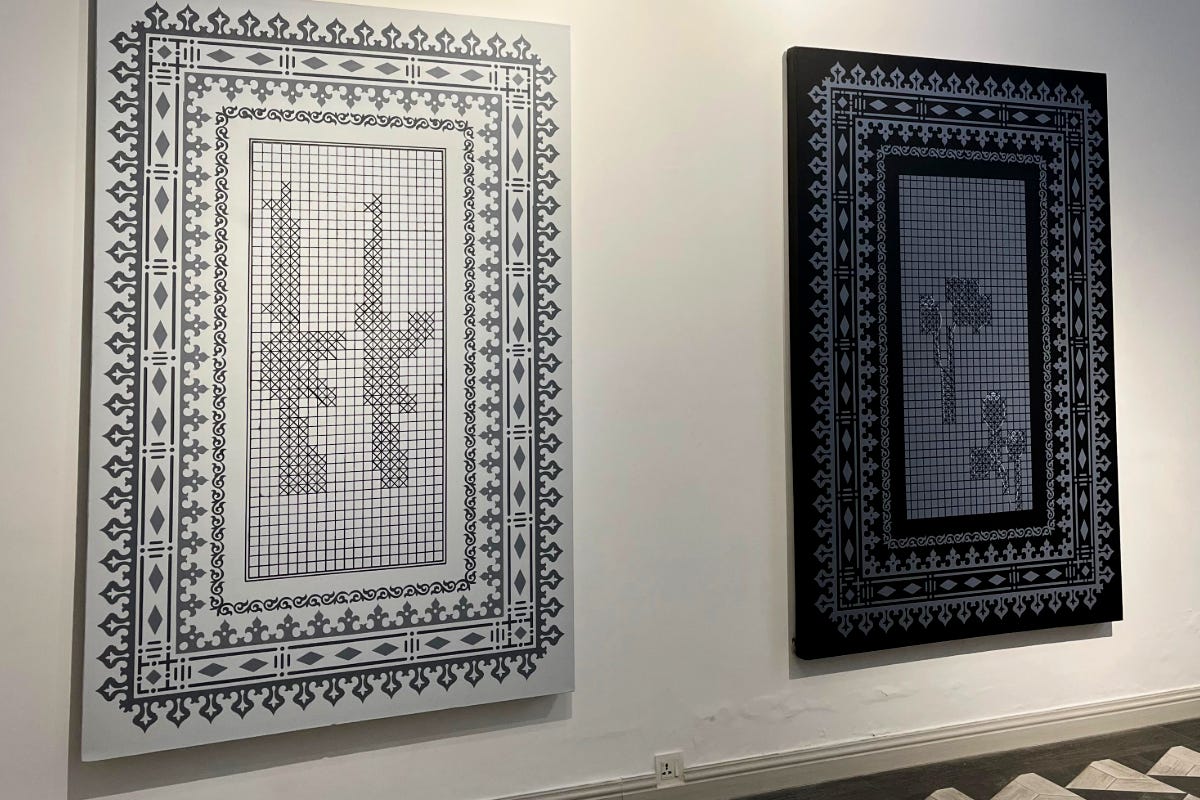
Image: (L) ‘G’ for Gun, 2026. (R) ‘O’ for Opium, 2026. 3 x 4 ft each.
2. Your paintings are named A, B, C, D – the first tools of colonial education. Tell us more about the broader crisis of cultural authority that the alphabet now stands for in Pakistan?
The Latin alphabet was not just a writing system introduced to the subcontinent; it was a statement about whose knowledge counted. When colonial education systems made English literacy the gateway to employment, status, and social mobility, they did not simply teach a language. They installed a hierarchy in which local languages, scripts, and ways of knowing were implicitly marked as backward, insufficient, and in need of replacement.
In Pakistan today, that hierarchy has not dissolved; it has been internalized. English medium education is still understood as superior. Families who cannot afford it feel that shame. Professionals code-switch into English to signal credibility. The Urdu script, Sindhi, Punjabi, Balochi, these are still treated as secondary in formal and institutional spaces. The alphabet, in this sense, stands for a crisis of cultural authority that we have not yet resolved or even fully named. We accepted the colonial valuation of knowledge so completely that we now enforce it ourselves.
My paintings use the Latin alphabet as a naming system to hold it up for examination. By pairing each letter with a symbol of empire and framing it within the jadwal of Mughal miniature tradition, I am asking: what did we learn when we learned this alphabet? What did we agree to forget?
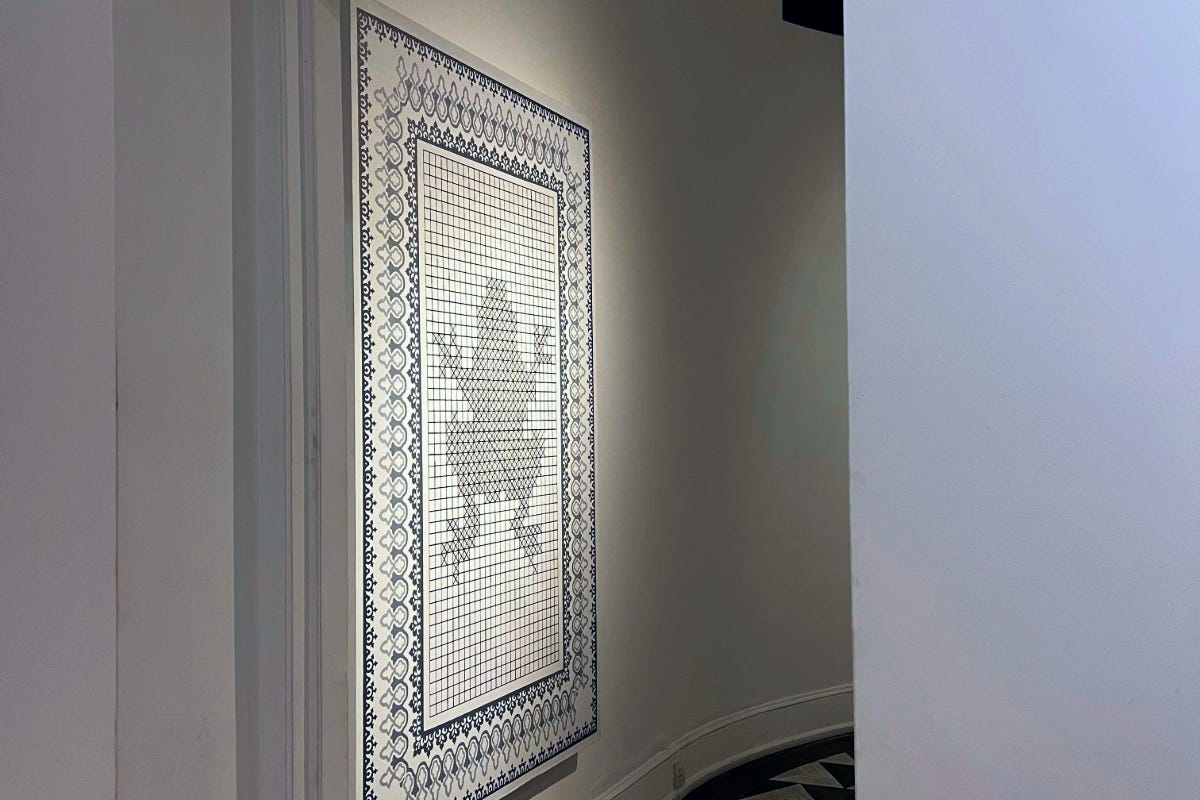
Image: ‘F’ for Frog, 2026. 3 x 4 ft.
3. Could you speak to the artistic choices that led to the ornate frames (jadwal) in your works? What made you pick these motifs?
The jadwal and hashiya are framing devices from the Mughal miniature painting tradition, which ruled ornamental bands and decorative borders that organize the space of a miniature, separating the image from the world outside it. They represent centuries of indigenous visual knowledge, a highly refined formal language that was developed long before colonial contact. I chose them for two reasons that work in tension with each other. The first is reclamation by placing colonial symbols inside these frames. I am asserting that this indigenous visual language has the authority to contain, examine, and pass judgment on what the empire left behind. The jadwal does not submit to the colonial image; it holds it.
The second reason is more uncomfortable. The jadwal also functions as a grid, a structure of order, repetition, measurement, and control. In this sense, it mirrors the very logic of the colonial systems I am critiquing. That double meaning is intentional. The series lives in that tension between indigenous form and colonial structure, between resistance and inheritance. The frame is not innocent. Nothing in this work is.
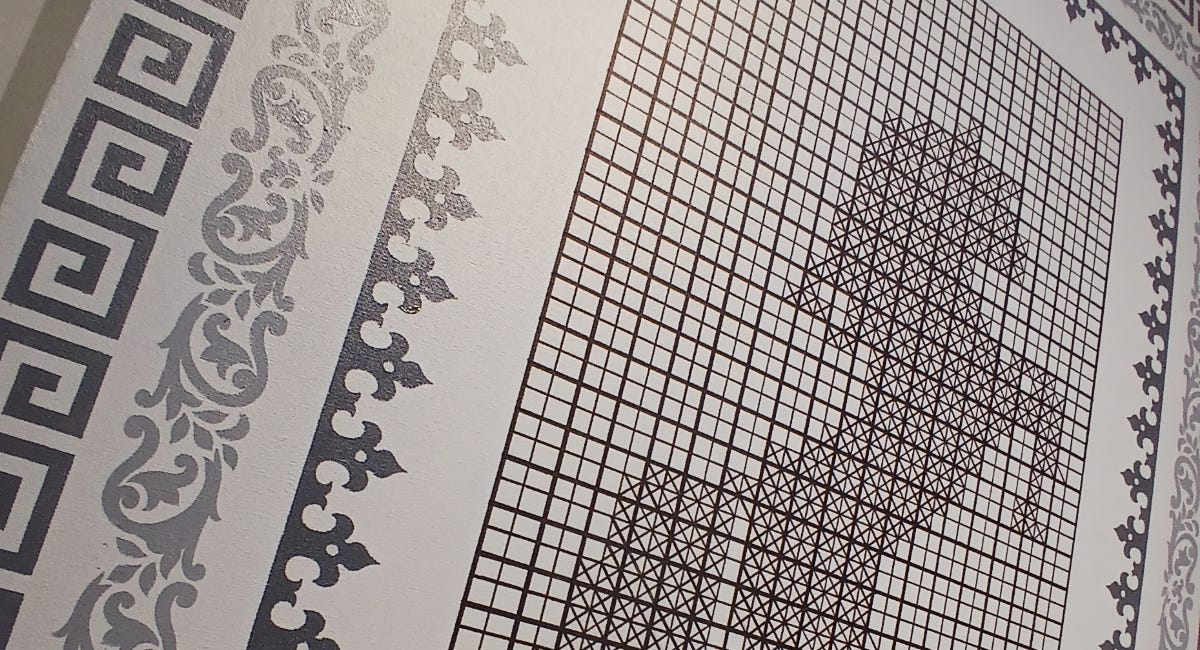
Image: ‘H’ for Horse, 2026. 3 x 4 ft
4. What made you deviate from the colour palette for K (Knighthood)?
The colour chose itself, honestly. Red came from the red carpet, authority, power, and the performance of importance. It felt like the most honest visual language for what knighthood actually was, a staged ceremony designed to make loyalty look like honour. The other works didn’t need that kind of spectacle. K did.
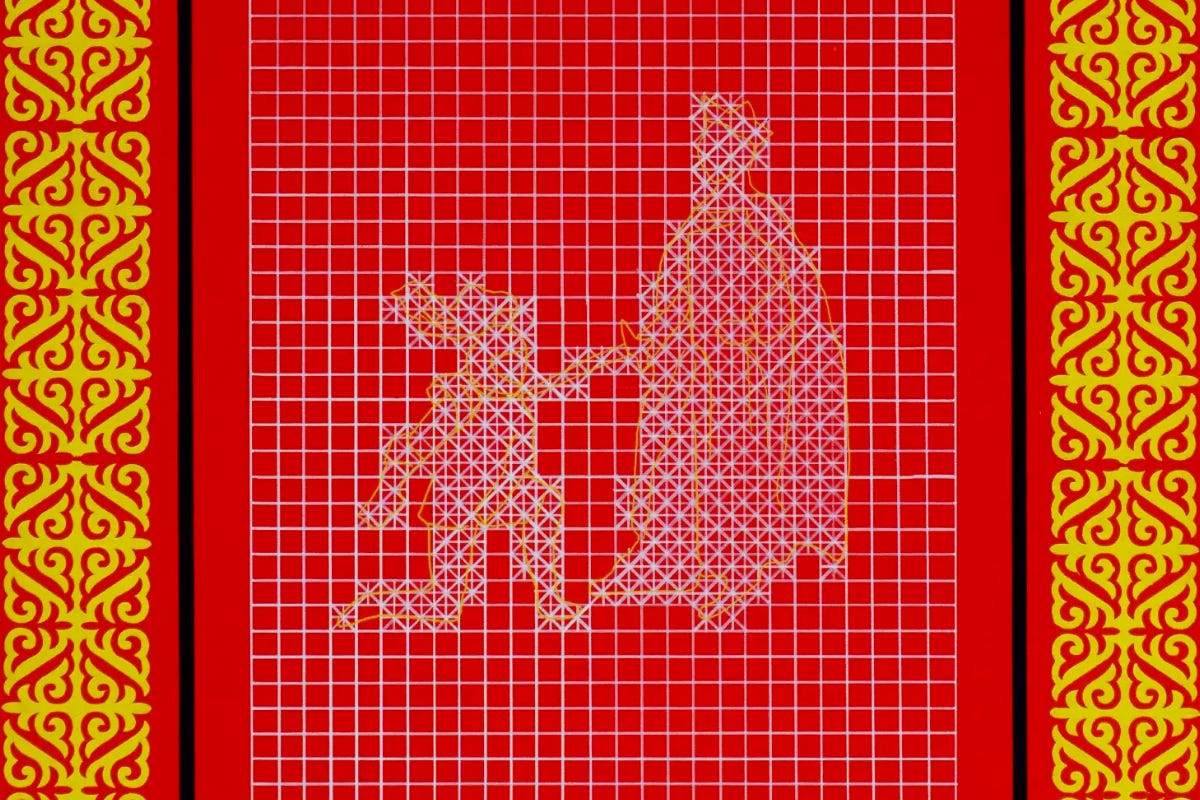
Image: ‘K’ for Knighthood, 2026. 3 x 4 ft.
5. If you could go back to the beginning of creating this series, what would you tell the artist you were then, knowing the journey these works would take you on?
I would tell myself to trust the slowness. At the beginning, I was impatient. I wanted the work to say everything at once, to be loud about what it was doing. What the series taught me, painting by painting, is that the most powerful thing I could do was to be quiet and precise. The grid is quiet. The jadwal is patient. The objects sit inside the frame without explaining themselves. That restraint took time to arrive at, and I would tell my earlier self to stop filling in the silences. I would also tell myself that the work would ask more of me personally than I expected. You cannot spend this much time with colonialism’s afterlives in archives, in objects, in your own education and upbringing, without it becoming uncomfortable in ways that are not purely intellectual. The research reaches back into your own formation. That is not a problem to solve. That is the work.
The LMSA Take
In ‘Grids of Instruction’, Ali’s impeccable line control is deadpan satire disguised as precision. Standing 4 ft tall, his oil-on-canvas renderings of a gun, a frog, an opium flower, and other familiar shapes are so meticulously crisp they read as giant vector prints rather than brushwork: a sly artistic choice, where the handmade painstakingly impersonates the machine-made. The two-toned, mostly neutral palette mimics institutional seriousness, but the joke deepens when you spot these colonial symbols trapped inside the ornate jadwal borders of Mughal miniatures: guns framed like a prized manuscript illumination, an opium flower treated with the reverence of a courtly portrait. Ali reclaims visual sovereignty as he pokes fun at the pomp and hierarchy that the empire sold us, treating the alphabet like a set of absurd museum specimens.
The artist is forcing us to recognize how our taste, knowledge, and even our sense of self-worth were systematically taught. His precise compositions turn the canvas into a classroom where silence hits harder than spectacle, and you’re finally asked the right questions.
Explore more works from the ‘Grids of Instruction’ collection on LMSA.art